In previous post, I mentioned how the universe developed after the big bang. But what is the future hold for the universe? I believe I would not be alive to find it out. The universe is still long to reach its ends. No one knows how exactly the universe is going to end, but scientist can roughly figure it out.
As we know earlier, the universe started by big bang and the space expanded. The expansion of space is faster than the speed of light. What is it exactly infer when the space expands faster than the speed of light? As a result of space expands faster than the speed of light, we will have what it is called event horizon.
There are few types of event horizon. The first type is near the black hole itself. Black hole is actually created after a supernova explosion of a massive star. When the massive star core collapse, the core become very dense. It is so dense that at the escape velocity at the surface of that core is higher than the speed of light. In fact, at some point near the core surface, the escape velocity is still greater than the speed of light. When we go further away from the super dense core, the gravitation pull become weaker and at some point light can escape from the gravitation pull of the black hole. At that point, we called it event horizon or also known as point of no return. This is because; when light falls beyond the boundary there is no possible way it can escape. The reason we called it event horizon is because the event happened beyond the horizon is unobservable.
 |
| The Newton's law of universe gravitation. |
 |
| The escape velocity-when the M increases the escape velocity increases as well. |
So, come back to the topic where the universe is expanding faster than the speed of light. Whether how the universe is going to end, we need to know the pace of expansion of the universe. One of the theories is the big crunch. This situation will happen when the universe’s expansion is slowing down and the cooling of universe converting more and more energy into matter. Since matter exert gravitation pull, the more matter the higher the gravitation pull is. Eventually, there is enough matter that can stop the expansion of universe and reverse the expansion. Then, all matter would collapse into black holes, which would then coalesce producing a unified black hole or Big Crunch singularity.
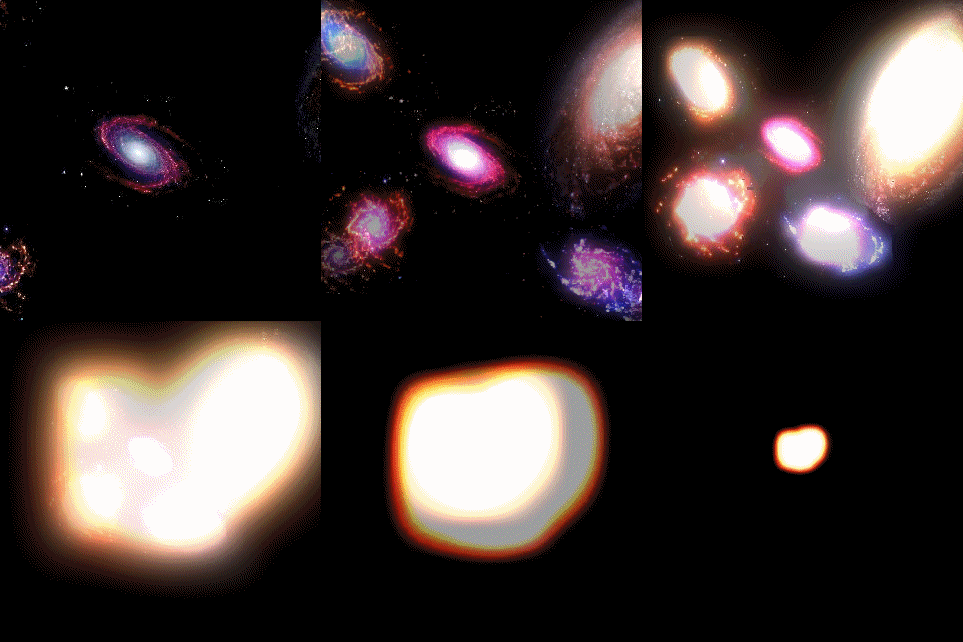 |
| Illustration of Big Crunch |
The other theory of the ultimate fate of universe is the big rip. Saul Perlmutter, an astrophysicist at Lawrence Berkeley National Laboratory had discovered that the universe expansion is accelerating (by observing Type 1a supernova). The universe expands at an ever-increasing rate. However, this implies that the size of the observable universe is continually shrinking; the distance to the edge of the observable universe which is moving away at the speed of light from any point gets ever closer. When the size of the observable universe is smaller than any particular structure, then no interaction between the farthest parts of the structure can occur, neither gravitational nor electromagnetic (nor weak or strong), and when they can no longer interact with each other in any way they will be "ripped apart".
Although, the universe is expanding in ever-increasing rate, the ultimate fate of the universe is still unknown as both of the theories relies on the key factor which is dark energy. Dark energy is believed to accelerate the expansion of the universe. But its nature is still unknown and it could one day reverse and cause collapse.
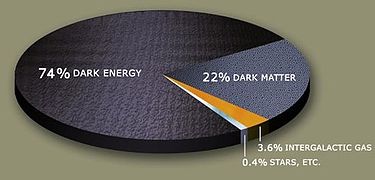 |
| Estimated distribution of dark matter and dark energy in the universe |
Whatever the fate of universe, it does not really give any impact to me. I just want to know a little bit more about the universe before I die. I do not want to die without knowing anything about the universe and that drives to seek for knowledge regarding the universe. There are still many of unsolved mystery of universe but as time goes by it will be unveiled.